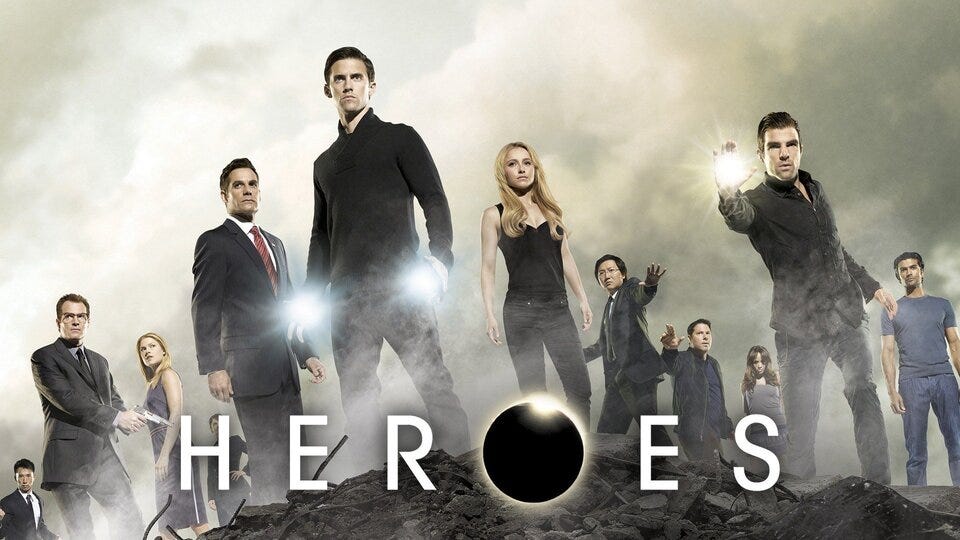

He had her at “hello.” Heroes had me at magic mobsters.
A man warns another, he may need a talisman to tell reality from fiction. Several characters have the ability to enter dreams, trap you in them, and make your dream world resemble the outer world. A brick wall in a basement is a giant brick wall in the dream. One hour in reality is one year in a dream. Heroes predates Inception by some time, or some viewers might think the series borrowed from it.
A fan boy/fan girl show proudly admitting it is, Heroes itself is clearly based on the principles from X-Men and X-Men’s own reflection of the Holocaust and every human anti-”them” movement in history. Anything of “not us” = bad. You know people reviewing this series thought it was fake again, this world might never happen. In the 2020’s, we’re starting to see more again that anyone “not us” does equal bad to many. We don’t have enough shows like this.
Heroes is one of those television shows where the conventional wisdom of things and my own opinion part ways. Season one is unquestionably the famous one. It’s the season that became a phenomenon and gave us that, “Save the cheerleader, save the world.” Weirdly, I was old enough in 2006 where I should remember that everywhere and don’t. My memory is of heavy TV and print marketing with that phrase. Reddit tells me otherwise.
But for me, the most interesting material comes much later, particularly in season four, when the series really starts digging into the complexities of Sylar, our serial killer. His entire season four storyline feels like something pulled out of The Twilight Zone or a classic sci-fi film. Everything against Matt Parkman, which you friends will all see when you get that far in, and yes, you will need to survive the lameness of some of season three to get there. Identity, isolation, morality, reality itself: Sylar becomes far more interesting once the show starts asking what actually happens inside the head of someone who has spent years becoming a monster. Zachary Quinto gets much more to play than simply being the creepy villain stalking everyone. He is a metaphor for mental health. Relatable, surely, to many of you, when we subtract the serial killer part. Desiring. Fearing solitude. Wondering if this is all there is.
In fact, Sylar is also one of the few characters on Heroes who consistently seems capable of thinking. I would put Hiro and Ando alongside him as the show’s most intellectual characters, followed by Micah Hawkins and his father, D.L. Hawkins. Everyone else seems periodically determined to make the dumbest decision imaginable. What show are we supposed to be watching again? Heroes would probably be a considerably shorter television series if everyone occasionally sat down for five minutes and thought about what they were doing. Like perhaps, “There is a serial killer with magic powers on the loose. Do something!” Oh no, let’s not. Until the next time. Again. Again. AGAIN. These are the people in a horror movie who get off the major highway to use the bathroom in a Southern ghost town.
After season one, the storytelling fluctuates wildly. There are stretches of Heroes that could be edited together into one of the greatest science fiction movies ever made. The concepts are that good between everything for me to have kept going. Then there are lots of scenes that feel like reality television filler, where characters stand around discussing something we just watched happen because the show apparently needs to fill another few minutes of airtime. That inconsistency becomes part of the Heroes experience. You deal with it, or you skip through the bits of Noah Bennet rambling again. Nobody tunes into this show to see a 90’s sitcom about dad-daughter bonding poorly remade a decade later. We’re here for the thrills.
A season three (?) climatic scene with Sylar and Claire alone is legitimately top tier horror/sci-fi cinema history forgotten forever because it was part of Heroes.
Characters also have an odd habit of entering the story looking tremendously important and then simply disappearing. Claire the cheerleader accumulates the cute boys in her life who appear positioned to matter to the larger story, only for the series to seemingly forget they ever existed. It gives the mythology a strangely disposable quality: never become too attached to a subplot because it may quietly wander away. Maya, where did you go? Justin Buldoni’s character whatever your name was, you appeared and left! Did you lead Claire on!?!
One thing I hate about the current conversation around Heroes is that there really isn’t enough of one. With all the parallels to racism, the Holocaust, difference being treated as disability, persecution, and the fear of people who are deemed abnormal, this is exactly the kind of older, correction, any TV series people should be discussing. Heroes reaches into these themes with more effectiveness than many new films and even news segments manage. The superpowers are fantasy, but the human impulse to categorise, fear, control, and eliminate people for being different certainly isn’t.
Hiro’s character arc is so brilliant that you could practically carve his story out of Heroes and give him and his BFF Ando their own series. Their relationship encompasses jealousy, betrayal, loyalty, family, shame, friendship, ambition, and forgiveness. Beneath all the science fiction and his bursts of “Ya tai!”, there are wonderfully ordinary human emotions driving them and Hiro’s family. And so much of it is beautifully acted in Japanese. WOWWWWW.
That becomes even more remarkable when you remember this was American prime time network television from roughly two decades ago, and we have not much of that today to my awareness. A substantial portion of the series unfolds in languages other than English, with Hiro’s storyline in particular allowing Japanese dialogue to simply exist as part of the show. Maya and her brother stole the show with their Spanish language narrative. This series doesn’t treat another language as an exotic garnish. It lets major characters live, joke, argue, grieve, and develop in it. Besides, duh, you speak things other than English outside America. Only Quentin Tarantino understands that.
There’s another accidental advantage to watching a series made before smartphones swallowed modern storytelling: limited cell phone technology forces the characters to actually do things. They have to go places and chatter. They have to find people. They miss information. They can’t instantly solve every logistical problem by staring at a screen. Technology exists, but it doesn’t become the setting. The limitations of the special effects also work in the show’s favour. Heroes can’t constantly throw gigantic spectacles at us every minute, so the powers are often integrated into otherwise ordinary environments and the story has to carry the excitement in writing. Strong writing. The effects arrive when they’re useful rather than devouring every scene. Better storytelling because they couldn’t overdo the effects? Hip hip hooray! What effects remain lean practical.
Then there’s Noah Bennet. Yeah, Claire’s dad. For a character given so much screen time and importance, Claire’s father has to be one of the most boring characters on the show, or any show, any MOVIE. He’s also frequently rotten as a human being, which might be fascinating if I found him more interesting to watch. Instead, whenever the series returns to him, I’m usually waiting to get back to one of the moving pieces of the screenplay clock, if we quote Sylar. Don’t ask me how such a bad dude makes for really bad TV. He does.
People do heinous things, unspeakable things(!!!!) every season then patch up and become friends/family again. It all gets a bit ridiculous when the government turns on the heroes, X-Men style, and people act like nothing after it. Would you speak to any of these people again after some of what happens, well, did happen?!
“But I don’t want to watch science fiction!” you say. There is, however, another important feature of Heroes that deserves acknowledgement. The men are unusually attractive, Reddit users say. Look around old discussions and Reddit threads and you’ll find viewers of all genders enthusiastically appreciating Mohinder, The Haitian, D.L. Hawkins, and Sylar. The series is unusual in that the traditional female Hollywood attractiveness scale feels noticeably male heavy in the cast. I wholeheartedly agree, The Haitian was like a missing attractive action film star who needed more screen time. He got about one to two episodes during an eclipse theme. Come on.
And Sylar undergoes perhaps the most dramatic transformation of all. He begins with a deliberately ordinary guy next door quality and gradually arrives at the final season looking extraordinarily polished and hot. Apparently existential crises, telekinesis, and an increasingly complicated relationship with your own identity also constitute a makeover. Meanwhile, the female cast members largely look like however they did season one or when they were introduced, and are all sorts of frumpy, dressy, flashy, or dull today like real women. Interesting how the tables turned on Heroes!
Of course, the real standout is the dog playing Mr. Muggles, a series regular. Poor Mr. Muggles witnesses the good, the bad, the ugly, the weird, and the scary. Can’t a guy Netflix and chill with his dog treats?