
Hey fans of Babe; James Cromwell is in this! That’ll do, for this film going pig. Piglet? I’ll take piglet. Miss Piggy is awesome.
And with that, here are some random notes from me as I viewed The Green Mile.
Take things back to December 1999 here, the moment of this movie’s release. I was in seventh grade and obsessed with Oscar bait movies, and movies in general. This was one I missed theatrically but caught later, half-paying attention while doing homework. Twelve year old me needs to live on in late 30’s me, which is why I rewatched and chose this film for my return to movie reviewing in my personal journal. I haven’t reviewed films in years with all of the weird flack I was getting online. The fun of deleting personal social media is you aren’t up for scrutiny. Wait until people find out about how I eat vegan corn dogs with Cholula sauce. The veggie food police will show up. Ha! NOT. Socials are gone.
Seeing Tom Hanks as a younger man again feels strange. I genuinely forgot. I’m so used to seeing him as a mature actor with this enormous career, and here he is, still pre-Cast Away, a time travel itself.
I completely forgot the mouse storyline. The moment it became clear the mouse mattered, I was on edge, the edge of my seat, ummm, well, the edge of my bed surrounded by furry little ones, wincing every time it might be in danger. And, unfortunately, I was right. There is violence against the mouse. Grrrrrr. I hate this, partly because I know there are people who can’t separate fiction from reality and take inspiration from films in the worst ways when it comes to harming animals. You’re going to say, “Sure, they say the same thing about video games.” I won’t get on that, but yes, as far as animal violence, it’s a different crowd, and some are children who look at pop culture growing up with the idea it’s OK to beat a horse or kill a mouse.
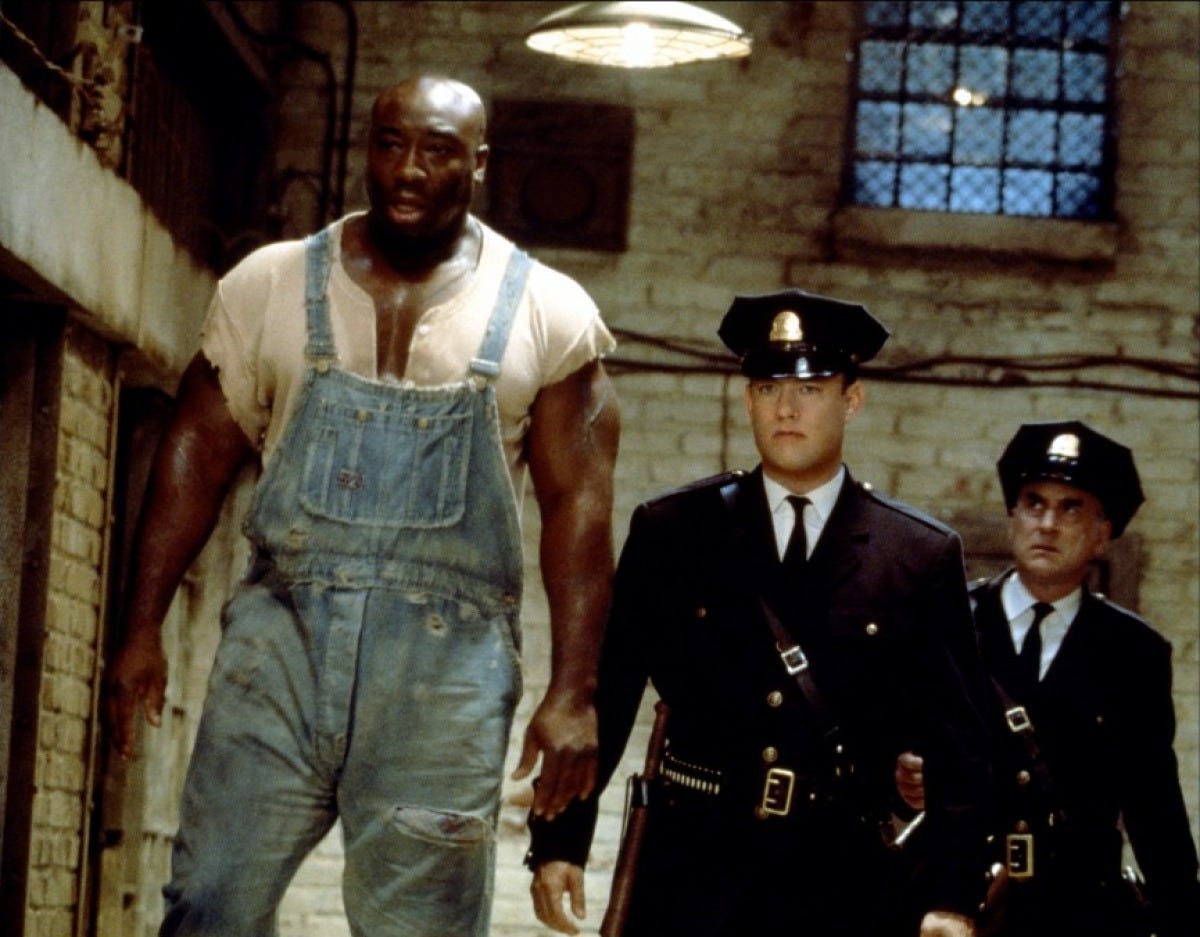
Watching this in December 2025, over a quarter century after its release, I’m fully aware of the flaws people point out now, like the “magical Black character” trope, for one, and the questionable racism. While I can’t speak for how tropes affect the black community, and I’m not going to pretend to stick my nose in where it doesn’t belong without those life experiences, I do think that any racism present in the dialogue or storytelling is, unfortunately, accurate to this film’s setting of Depression era Louisiana.
What we talk about less is the classism among the white characters. Being a white man during the Depression gave you more freedom than Black Americans, but you were still beneath people like Percy, a prison guard who mistreats everyone and is protected by his uncle, the governor, and who knows who else in his influential family. Percy sees everyone as lesser, and for most of the film, those beneath him in the hierarchy can’t do anything about it. Or they choose not to, knowing they won’t get ahead very far in disciplining him.
The film explores the contradictions and possible innocence of death row inmates well, but I wish it went further. We only see a few inmates, all within a very tight, single room set with fake looking peeled green paint. For what was actually spent on this movie, Tom Hanks’ salary alone probably more than some blocks of houses’ real estate values combined, the production often feels oddly restricted to the stage, where things might have passed. At times it looks like a filmed play. For a low budget film that would be fine or revolutionary, but here it made me think, NOPE.
Michael Clarke Duncan was a remarkable actor, and I truly believe we were robbed of seeing the icon he might have become. Tom Hanks is undeniably talented, but watching this, I was always aware I was watching Tom Hanks playing a version of Tom Hanks, tears and all, nothing he can do about it. Michael Clarke Duncan, on the other hand, commands attention just by entering a room. His face twisted into a look, a tremble of the lips. And I never once thought about his other roles while watching him here. He was John Coffey. Not the dude from The Island.
The Green Mile sits at the top of the Stephen King adaptations to film for me, with The Shining right behind it.
What I loved most about starting my reviews again with this film is how THIS IS A MOVIE!!!! it feels. In 1999, movies looked and felt like movies. I know digital can look incredible, sure, OK, grain can be added back, visuals can be stunning. It’s harder for me to feel immersed now. Editing is hyperactive. Sound design can be distracting. Performances sometimes feel pushed by trends rather than emotion, or overacting from a director who thinks everyone should overact because the last hits he saw were all overacting. Guys, you don’t need your actors to move your eyebrows into a newspaper maze puzzle shape when they tell the waitress, “I want my coffee black.”
Watching The Green Mile hit all the marks of what a film is felt deeply comforting. I’ll take a flawed movie with empathy over a generic 2025 release that has none for the viewing experience. And honestly? I would watch Michael Clarke Duncan like a total fangirl even if he starred in a Mary-Kate and Ashley direct to VHS movie. As with the lead character here, his acting talent was a miracle taken from us too soon.