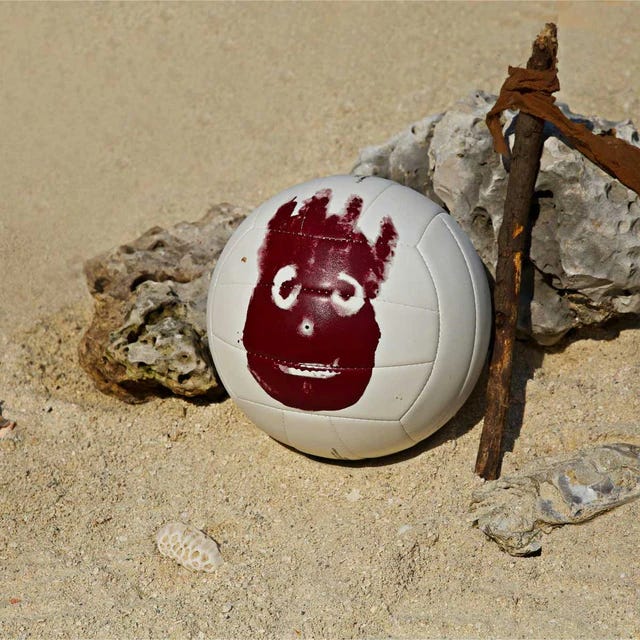

Hey, it’s the movie where Tom Hanks co-stars with “Wilson” the volleyball! Remember when Jay Leno had a field day, ermm, field late night? Field daytime taping? making fun of that?
Rewatching films from around the year 2000 sometimes makes me realise how much I took the polished cinematic experience for granted as a teenage drama queen, ha, Lohan reference of course. Cast Away feels like one of the last films of that era where everything simply works: the camera angles, the editing, the script, the pacing, the dialogue, real FedEx’s involvement. It’s the kind of filmmaking that feels confident without announcing itself all flashly like, “We filmed this on digital and made it look hipster again with fake grain!”
There was a time when this level of craftsmanship was simply expected, friends. I’ve seen Cast Away more times than I can count, mostly because I once watched it on loop while bored in a hotel room with HBO or some movie channel. After that marathon of me trying to see what to do as my dad was at the conference as usual, I’ve caught it here and there over the years, including again last weekend on Netflix. What never changes is the strange shock of the ending. Every time I watch the final half hour, it somehow still feels different from what I remembered, and whenever I think of this movie, all I recall is how good the rain looks in matching his character’s heart.
Tom Hanks may have had many iconic roles, but this is arguably his best in script and the best he’s played. Normally, when I watch him perform, a small part of my brain still whispers, “Look at Tom Hanks on film, behold, the movie star.” Here, though, that thought disappears. His performance shifts so dramatically across each chapter of the story that the illusion holds up A-ok. The man we meet at the beginning is practically a different person from the one we see later. Hanks brings it.
Watching it now, though, there’s a slightly sad element that lingers. This is also the film where, truthfully, by his own admission and according to widely reported details, he dramatically altered his body for the role, gaining about 50 whole pounds before losing it again for the island sequences on purpose. That kind of transformation can’t be easy on anyone’s health, and it’s hard not to think that some of it could have been achieved with prosthetics instead.
At the time, the film also arrived during the cultural moment when the first season of Survivor had just exploded into popularity. Suddenly the idea of watching someone endure isolation and survival against nature had enormous appeal. My junior high self was absolutely part of that audience!!!! “OH YEAH,” my inner Kool-Aid man said, so excited when this movie came out. Later on, I smashed through a local showing’s cement wall with a smile.
The survival elements of the film also reminded me of the Gary Paulsen novels I devoured when I was younger—stories like Hatchet, where endurance and ingenuity become the entire narrative engine.
If the film has one real weakness, it’s the realism. No man survives a plane crash while dangling his flotation device like an evening purse clutch at the Oscars. The logistics of the crash itself feel a little too tidy for what follows, that crash scene being more roller coaster ride.
But realism isn’t really the point of Cast Away. It’s about endurance, time, and the strange way life continues after catastrophe.
And then there’s the final scene, where you feel lost. Somehow, every time I revisit the film, my brain forgets exactly how it ends like nothing. When it arrives again, I’m left with the same confusion I’ve always had: what exactly is it supposed to mean here in deeper meaning? The symbolism is really unclear, in fact, that there are almost millions of methods to read it. Or misread it. What’s the film snob in me to do?
Perhaps that ambiguity is intentional. Or perhaps it’s simply one of those endings that refuses to settle into a single interpretation, so we deal with it like the movie elitist wannabes we are!
Either way, Cast Away remains one of those films that reminds me how powerful straightforward cinema used to feel, before we realised we were living in its heyday.