
Yorgos Lanthimos first landed on my radar with The Lobster, a film I enjoyed largely because it broke so many rules, the acting was depressingly spot on, it was ridiculous and strange. I loved it. You can guess that. My rule is simple: keep me guessing. If I don’t know what comes next, your film may not be perfect, but it will stand out from all the many movies I watch. Bugonia absolutely follows that rule.
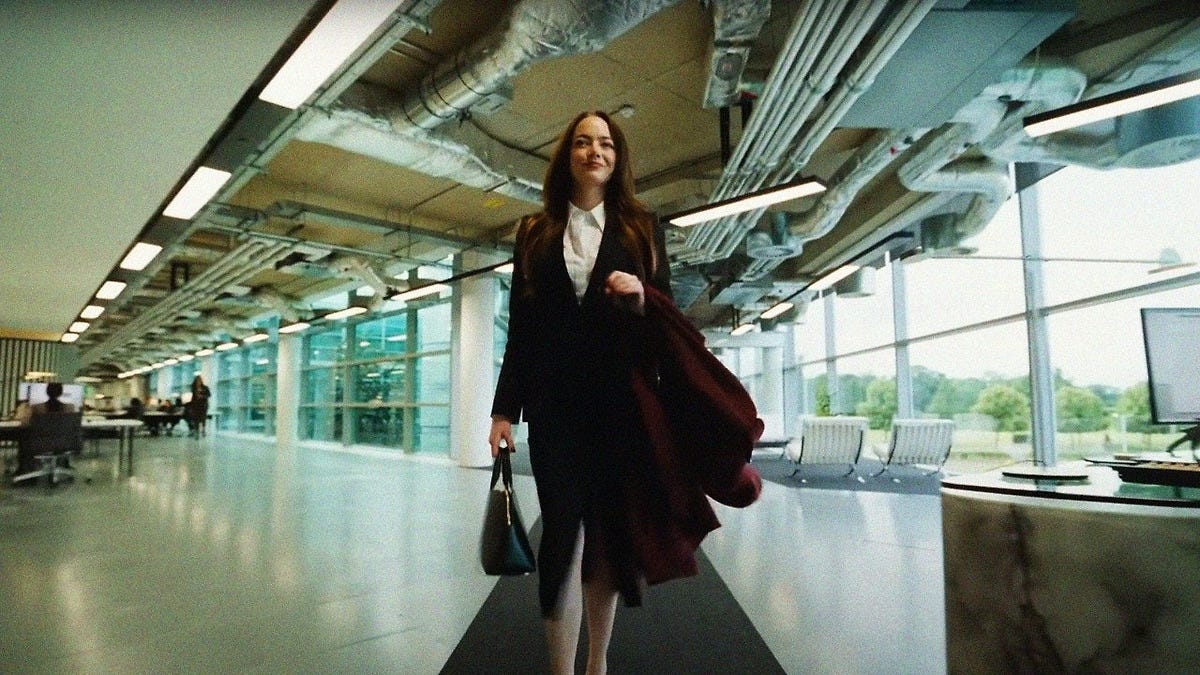
I didn’t come to this film for Lanthimos though, or for Emma Stone, his frequent collaborator. Seeing her transform herself from the tiny everyday gal I saw in person into this very loud, dramatic being is really powerful.
But no, I came for Jesse Plemons, an actor I find endlessly compelling on camera and might I add, with hate mail from Kirsten Dunst surely to follow *JOKE, a sexiness in how he carries himself on screen pre-Bugonia. He has an “everyday” quality that somehow translates into something more magnetic once he’s in motion. It’s not about conventional attractiveness like a Chris Hemsworth or old 1950’s Hollywood look. No, it’s about presence. The way he moves, the way he listens, the way he speaks. He’s got whatever that star power is supposed to have. Austin Powers mojo.
And notably, his voice never slips into that upspeak pattern that’s become so common. There’s a realness to him that feels increasingly rare as men all imitate YouTubers selling skin cream in informercial question marks.
Here, even styled scruffily, this is one of his best performances. His acting is so natural it almost disappears, as you feel less like you’re watching a performance and more like you’ve run into him on the street and fallen into conversation.
Aidan Delbis is also a standout, especially in a first major role. There’s a quiet confidence there that holds its own in a film that could easily swallow a newcomer whole.
The film itself is… absurd. Intentionally so. It leans into that Lanthimos tone of controlled strangeness, where everything feels slightly off-centre. Visually, it’s presented in a square aspect ratio, which I have mixed feelings about. As someone who has made no-budget films in that format to evoke the rugged texture of old film strips, I understand the choice. But here, it feels more like a stylistic constraint than a necessity. I found myself wanting a wider frame—more room to see the full basement, more space for the actors’ faces to breathe.
That said, the editing is fabulous. Sharp, deliberate, and full of snappy snap good rhythm. Whatever alchemy brought this film together, the direction is confident and packed with detail. It held my attention completely. I didn’t get bored once, which, for a film this oh WEIRD, is no small achievement.
There is one moment I didn’t like, ugh, a brief scene involving suicide that feels inserted for shock, perhaps even a punchline. It doesn’t land. Suicide isn’t funny, it’s never going to be funny, it never was, get real, and it isn’t light material. Having known people in my youth who made that choice, and having seen the impact ripple through everyone around them, it’s a note that feels out of place in an otherwise carefully constructed film.
By the end, though, the film offers a kind of sideways redemption, like, you know, a wink rather than a resolution. If you’ve seen Emma Stone in TV’s The Curse, you’ll recognise the tone. It’s that particular flavour she gravitates toward: unsettling, self-aware, just a little bit playful in its discomfort all around.
What’s perhaps most surprising is that Bugonia found its way into the Academy conversation at all. This isn’t their usual language. It’s too odd, too slippery, too uninterested in neat conclusions. The Academy wants things like a Lincoln biopic. Bugonia serves up experimental hamburgers made from alien moon cheese at Ruth’s Chris Steakhouse.
But that’s also what makes it worth watching. It’s weird. It’s intriguing. It doesn’t behave, like you and me are prone to. And sometimes, that’s exactly the point.